.png)

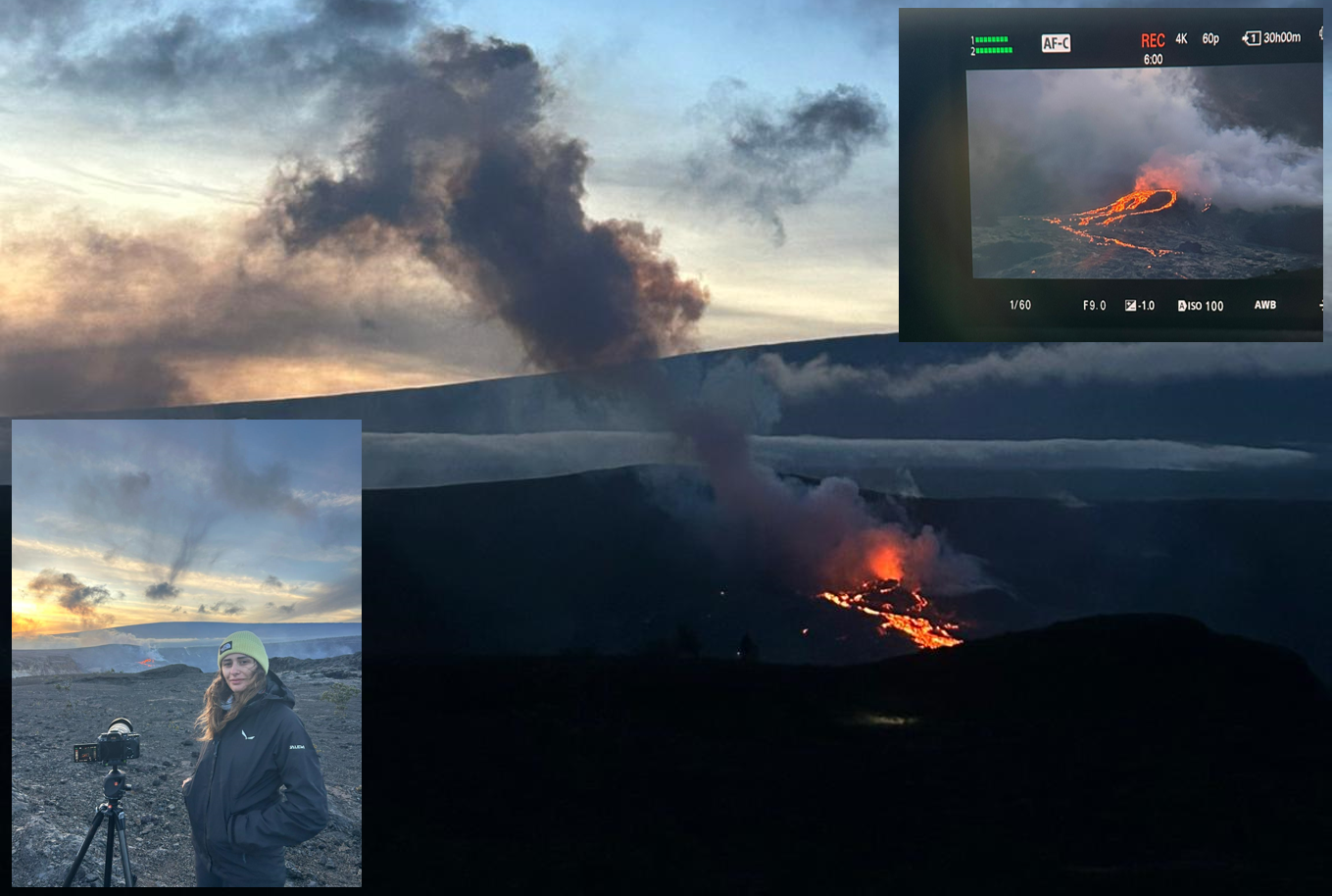
Our special envoy Arianna, currently in Hawaii thanks to her Fulbright research fellowship, witnessed firsthand the spectacular eruption of Kilauea.
The event, known as Episode 36, began at approximately 11:15 a.m. HST on November 9 and ended around 4:16 p.m. the same day. During the eruption, the southern vent fountains reached heights between 330 and 360 meters, while the northern vent fountains rose to about 300 meters.
In total, Episode 36 released just under 8 million cubic meters of lava, with a combined eruption rate exceeding 500 cubic meters per second from the two main fountains. The lava flows spread rapidly, covering roughly 80% of the Halemaʻumaʻu crater floor.
Arianna and her team were on-site to film the eruption’s precursors, such as lava overflows and fountain activity. They use high-resolution video footage to characterize eruptive events, measuring the height of eruptive columns, studying ash fallout patterns, and understanding the dynamics of lava fountains. To process this data, they employ AI-powered algorithms that analyze video sequences, providing valuable insights into the timing, intensity, and evolution of volcanic activity.
This unique combination of field observation, advanced imaging, and artificial intelligence highlights how technology is transforming the way scientists study one of Earth’s most powerful natural phenomena.
We’re all a little jealous of Arianna right now!