.png)


DEMETRA: Investigating the Interplay Between Volcanic Activity and Climate Change
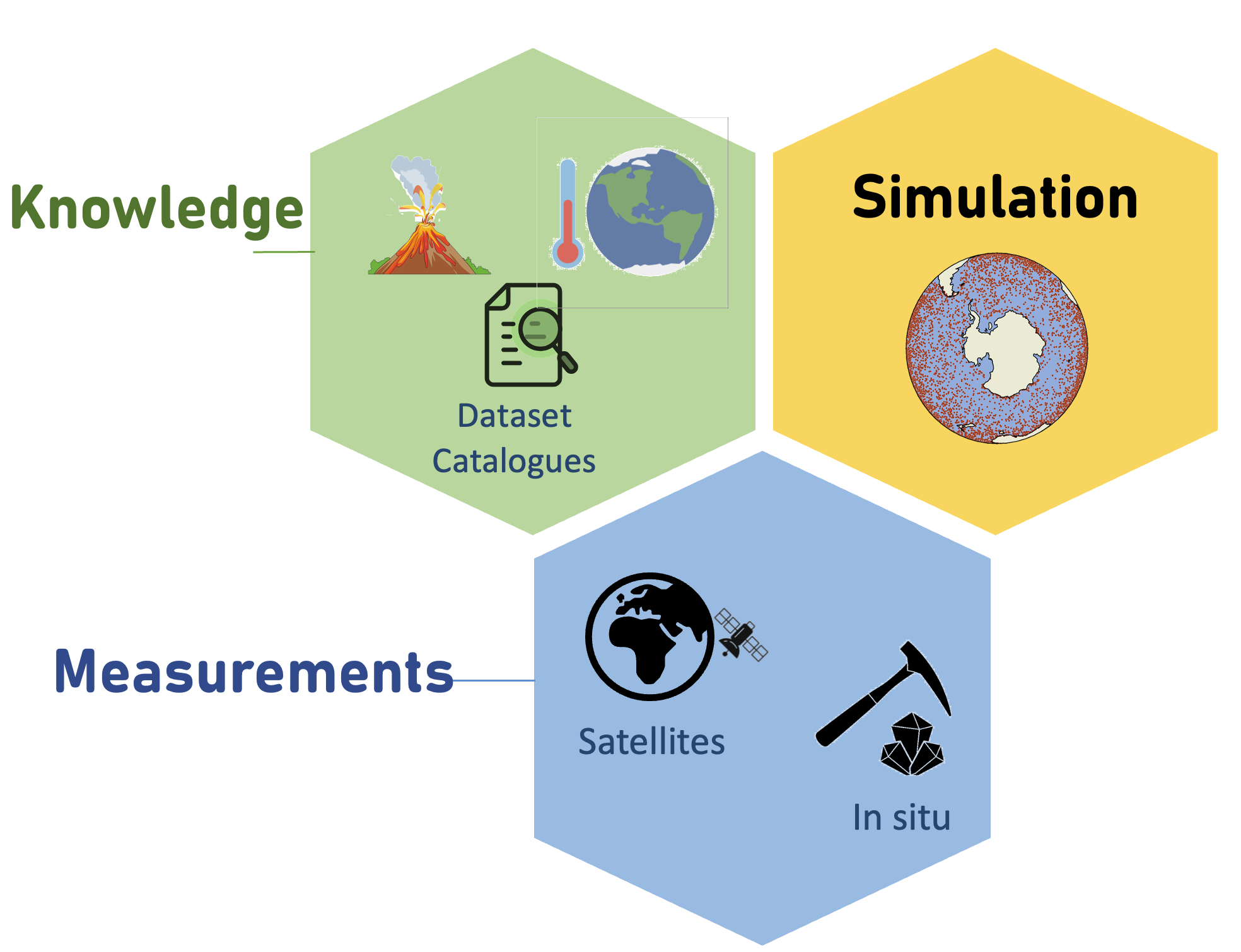
DEMETRA is a research line of the ROSE (Reinforcement of the Observational Systems of the Earth) infrastructural project of INGV, funded by the Italian Ministry of University and Research. Launched in 2025 as a three-year initiative, DEMETRA investigates how volcanic activity influences the Earth’s climate system, with a particular focus on regional impacts in the Euro-Mediterranean area.
By integrating numerical modelling, advanced data analytics and multidisciplinary observations, DEMETRA addresses both explosive volcanic eruptions and long-term passive degassing processes. The project aims to improve the understanding of volcanic forcing on climate variability and change, and to enhance predictive capabilities relevant for climate risk assessment.
Key objectives
-
improving the predictability and early warning of climatic impacts associated with volcanic activity;
-
identifying and fingerprinting volcanic signals in Euro-Mediterranean climate variability;
-
quantifying volcanic forcing from both eruptive events and quiescent gas emissions.
DEMETRA contributes to strengthening INGV’s observational and modelling capabilities within ROSE, leveraging advanced computational infrastructures and innovative methodologies developed at the TechnoLab of the Etna Volcano Observatory.
Scientific rationale
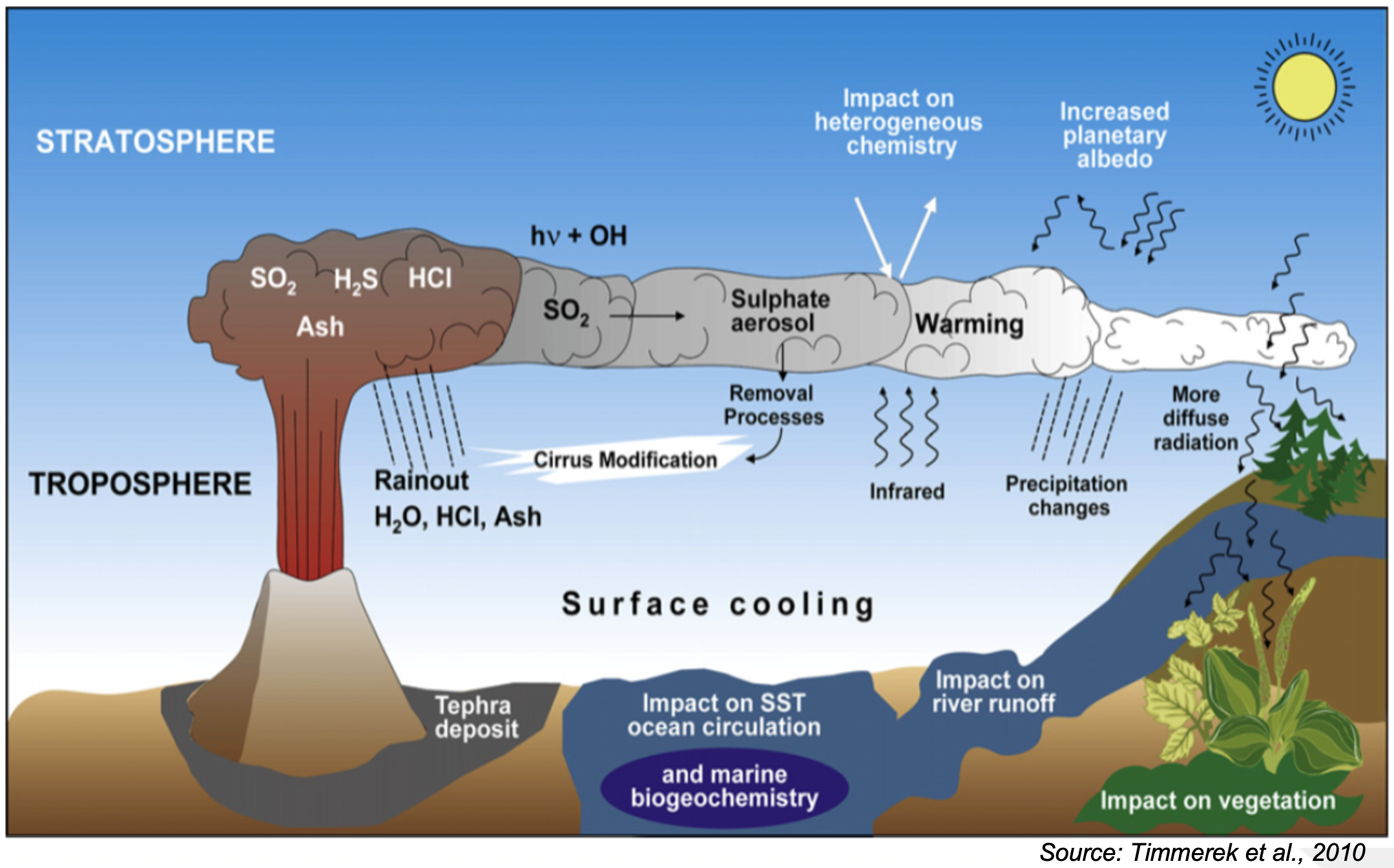
Explosive volcanic eruptions represent one of the most important natural drivers of climate variability. Large eruptions inject sulfur-bearing gases into the stratosphere, enhancing the aerosol layer and reducing incoming solar radiation, with consequent surface cooling. Beyond this direct radiative forcing, volcanic activity can trigger complex dynamical responses affecting atmospheric circulation, precipitation patterns, ocean–atmosphere coupling and longer-term climate variability.
In addition to explosive events, DEMETRA investigates the climatic role of persistent passive degassing from quiescent volcanoes and geothermal regions. These processes release greenhouse gases into the atmosphere and contribute to a background radiative forcing that remains poorly constrained in current climate models. Particular attention is devoted to periods of clustered eruptions, which may delay climate recovery and lead to prolonged environmental and societal impacts.
By addressing both eruptive and quiescent volcanic processes, DEMETRA aims to reduce uncertainties in the representation of volcanic forcing in regional and global climate systems.
Objectives
DEMETRA pursues three closely connected scientific objectives aimed at improving the understanding and predictability of volcanic impacts on climate.
Predictability and early warning
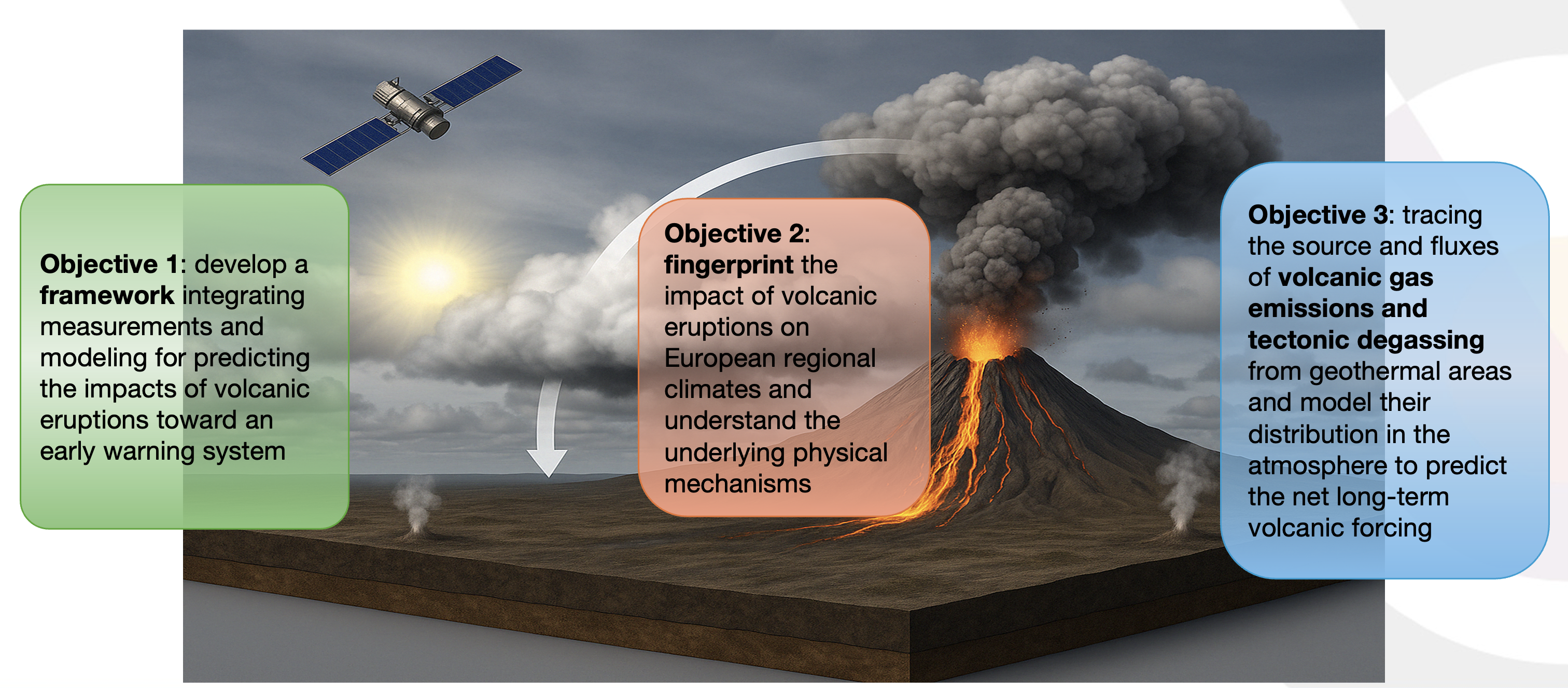
Develop an integrated framework combining observations, numerical modelling and data-driven approaches to assess the predictability of volcanic impacts on climate and to support future climate risk mitigation strategies.
Fingerprinting volcanic impacts
Identify and attribute the signatures of major volcanic eruptions in European and Euro-Mediterranean climate variability, clarifying the physical mechanisms linking volcanic forcing to regional climate responses.
Quantifying volcanic forcing
Quantify the sources, fluxes and atmospheric dispersion of volcanic and tectonic greenhouse gas emissions in order to estimate their net long-term climatic forcing.
Technologies
DEMETRA integrates advanced computational and observational technologies to bridge volcanology and climate science and to investigate volcanic–climate interactions across multiple spatial and temporal scales.
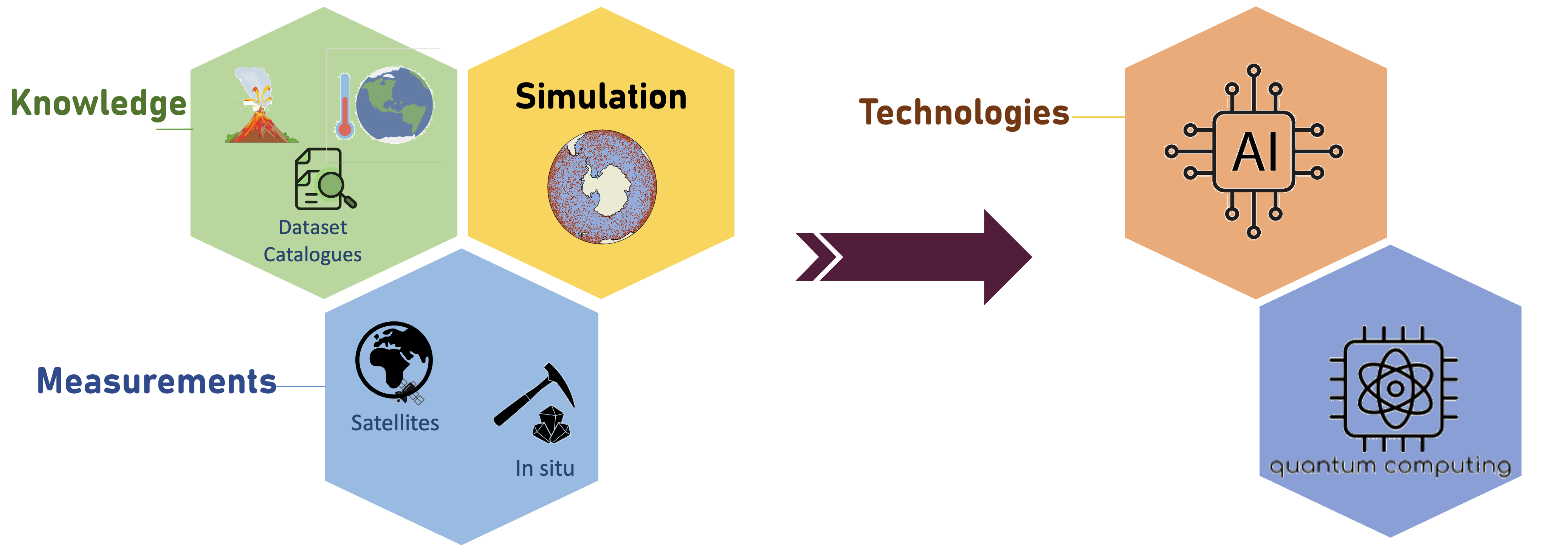
Artificial Intelligence and Machine Learning techniques are used to analyse large satellite data archives, enabling rapid detection and characterization of volcanic plumes, aerosols and gas emissions, as well as the nowcasting of their atmospheric dispersion.
Deep learning methods support the development of high-resolution climate model emulators, allowing large ensembles of simulations to be generated with substantially reduced computational costs. These emulators complement global and regional climate models and enable probabilistic assessments of post-eruption climate responses.
High-performance computing infrastructures underpin data-intensive analyses and large ensemble simulations, while emerging Quantum Computing methodologies are explored as a long-term perspective to enhance the scalability and efficiency of complex Earth system modelling.
Observational activities combine satellite measurements with ground-based geochemical and geophysical data. Advanced instrumentation is used to quantify volcanic and geothermal gas fluxes, determine their chemical and isotopic composition, and constrain subsurface fluid pathways, providing key inputs for atmospheric dispersion models and climate impact assessments.
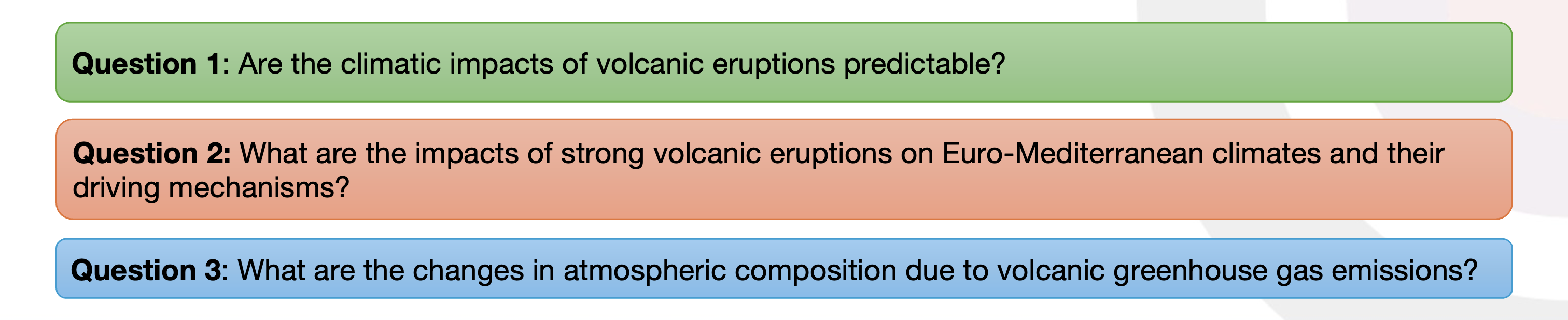
DEMETRA will answer these questions:
-
Are the climatic impacts of volcanic eruptions predictable?
-
What are the impacts of strong volcanic eruptions on Euro-Mediterranean climate and their driving mechanisms?
-
What are the changes in atmospheric composition due to volcanic greenhouse gas emissions?
Quantum Artificial Intelligence School
As a strategic extension of the activities promoted within ROSE, DEMETRA supports the Quantum Artificial Intelligence School, an advanced training initiative designed to strengthen competences in artificial intelligence, high-performance computing and emerging quantum methodologies for geoscience and climate applications.
The school adopts a strongly application-oriented approach, combining lectures with hands-on laboratories based on real INGV data, access to HPC infrastructures and cloud-based quantum resources. Within DEMETRA, the Quantum AI School contributes to the long-term sustainability of advanced computational infrastructures and to the development of a stable, interdisciplinary research community at the interface between volcanology, climate science and computational geosciences.
Key information
-
The Quantum AI School will take place at the end of September 2026.
-
Participant registration will open in early March 2026.
Project organization
DEMETRA Principal Investigators
Vito Zago (INGV – Etna Volcano Observatory, Catania)
Davide Zanchettin (Università Ca’ Foscari Venezia)
ROSE Project Coordinator
Ciro Del Negro (INGV – Etna Volcano Observatory, Catania)
Research Units (RU)
DEMETRA involves an international and multidisciplinary team organized into six Research Units (RU), covering complementary expertise in climate science, volcanology, geochemistry, geophysics, artificial intelligence and historical climate reconstruction.
- RU1 – Davide Zanchettin (Università Ca’ Foscari Venezia)
- RU2 – Vito Zago (INGV – Etna Volcano Observatory, Catania)
- RU3 – Alessandra Sciarra (INGV – Sezione Roma 1)
- RU4 – Paola Del Carlo (INGV – Sezione di Pisa)
- RU5 – Franco Tassi (Università di Firenze)
- RU6 – Luigi Dallai (Sapienza Università di Roma)
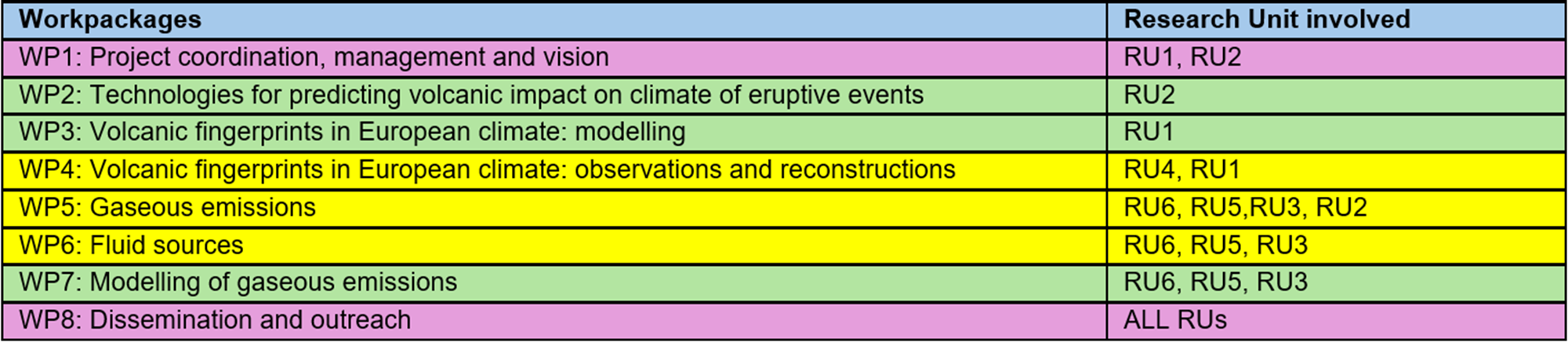
Workpackages (WP)
Research activities are structured into eight interconnected Work Packages (WP) covering coordination, technological development, modelling, observations, gas emission studies and dissemination.
Contact
For scientific and organizational information on the DEMETRA research line:
Email: