VT-CLAIM | Volcano, Tectonic and Climate–Atmosphere Interactions through AI and Multi-Source Data Integration
VT-CLAIM develops the first holistic, AI-driven framework to investigate causal relationships among volcanic activity, tectonic processes and climate variability by integrating more than four decades of Earth Observation data, field measurements and Earth system models.
Understanding a Connected Earth System
Climate, volcanic activity and tectonic processes are often studied separately, despite being interconnected components of the Earth system.
Climate change is altering glaciers, hydrological cycles, ocean circulation and atmospheric conditions, potentially influencing crustal stress, seismicity and volcanic activity. At the same time, volcanoes continuously release gases, aerosols and thermal energy that can affect atmospheric composition, cloud formation and climate variability.
Despite decades of satellite observations and ground-based monitoring, recent advances are creating new opportunities to investigate the mechanisms linking these processes.
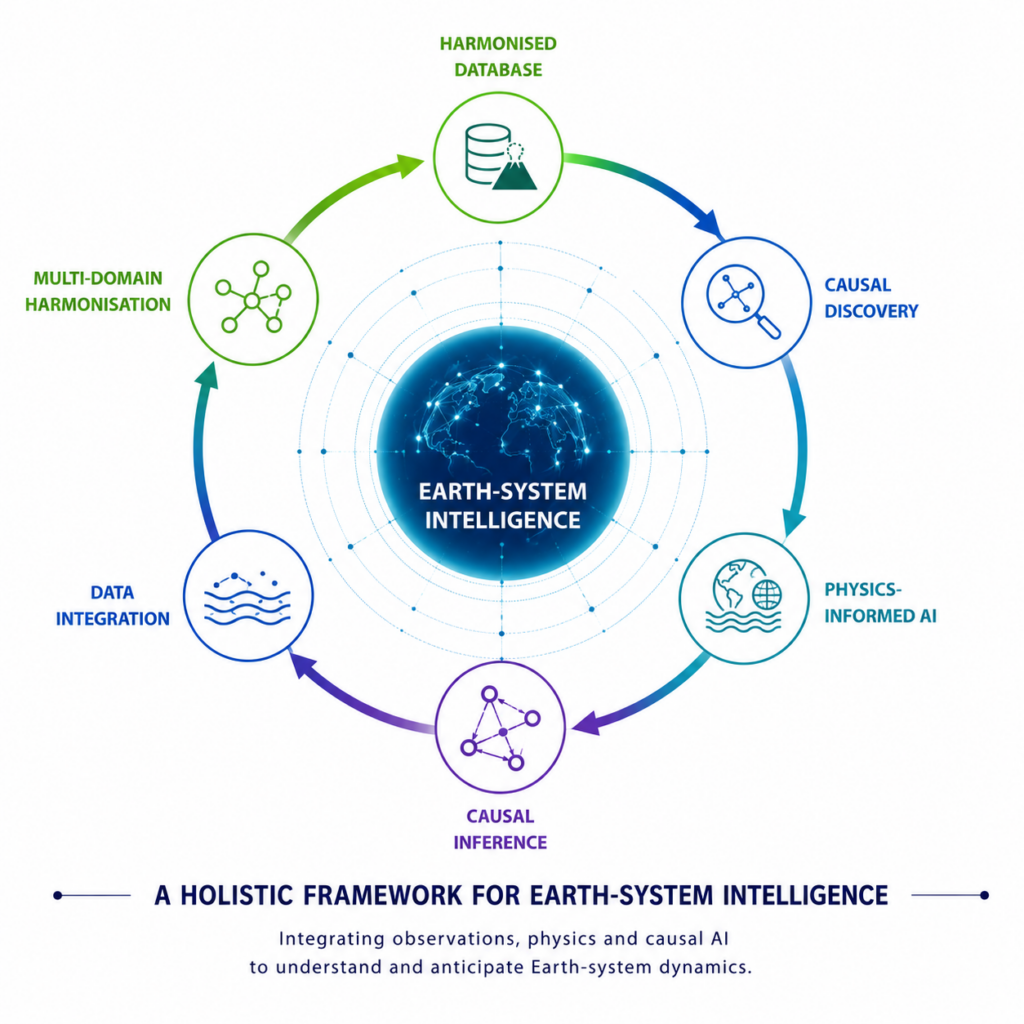
Building on these advances, VT-CLAIM combines Earth Observation, field measurements, climate modelling and Artificial Intelligence to identify physically meaningful interactions and potential causal relationships across the climate–volcano–tectonic system.
Work Packages
VT-CLAIM is organised into eight interconnected Work Packages covering data generation, field observations, Artificial Intelligence, physical interpretation, project management and dissemination.
WP1 – Coordination and Project Management
WP2 – Climatic Indicators
WP3 – Volcanic Activity Indicators
WP4 – Tectonic Activity Indicators
WP5 – Local-Scale Experiments
WP6 – AI Integration of Climate, Tectonic & Volcanic Data
WP7 – AI-Driven Physical Interpretation & Process Understanding
WP8 – Communication, Dissemination & Outreach
The VT-CLAIM research structure combines Earth Observation, field experiments, Artificial Intelligence and physical interpretation within a single integrated workflow.
Climate, volcanic and tectonic indicators (WP2–WP4), together with high-resolution observations from local-scale experiments (WP5), provide the scientific foundation of the project. These datasets feed the AI framework (WP6), where causal relationships and cross-domain interactions are investigated. Results are then assessed through explainable AI and process-based interpretation (WP7), ensuring scientific robustness and physical consistency.
Project coordination (WP1) and communication, dissemination and outreach activities (WP8) support all research activities throughout the project lifecycle.
AI Framework
From Data Integration to Causal Discovery
The VT-CLAIM AI Framework combines multi-decadal observations from climate, volcanic and tectonic domains into a unified analytical ecosystem.
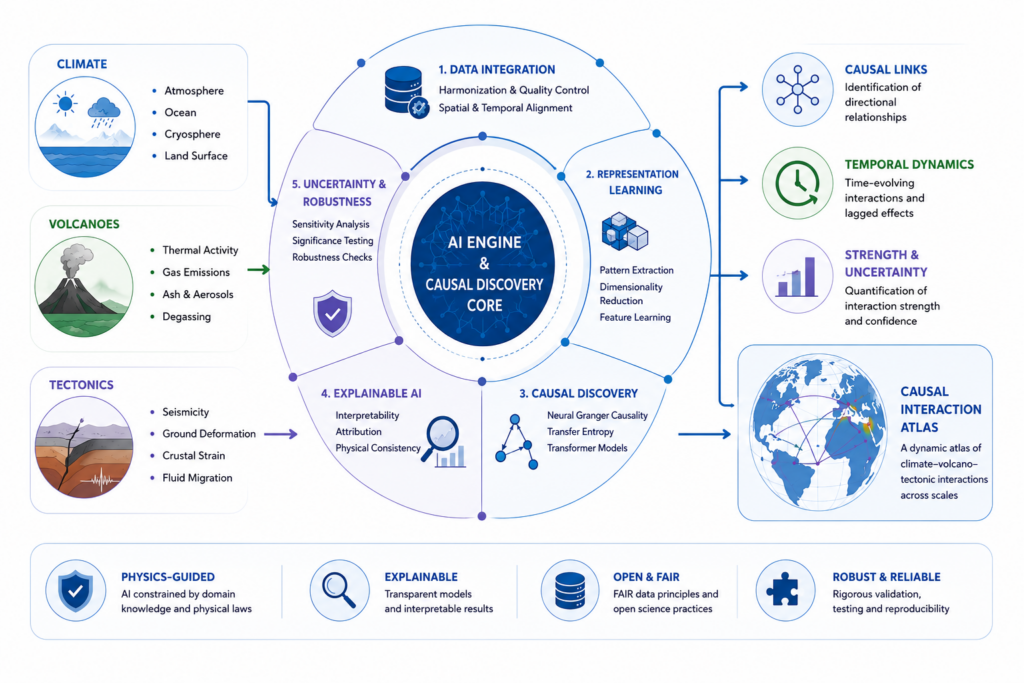
VT-CLAIM combines Earth Observation, climate data, volcanic and tectonic indicators within a unified AI framework designed to identify potential causal relationships across Earth-system domains. Advanced methods for representation learning, causal discovery and Explainable AI help reveal interactions, feedbacks and response times that are often hidden within complex environmental datasets.
The framework provides a scientifically grounded approach to transforming observations into knowledge, supporting the development of the Causal Interaction Atlas and a deeper understanding of climate–volcano–tectonic interactions.